
There’s something kinda magical about measuring stuff, isn’t there? Like, you’re standing there with a little jug of water, or maybe a scoop of all-purpose flour, and you just wanna know: how much does this weigh exactly?
It’s funny how in one hand, we have milliliters (mL) whispering “I’m a measure of volume,” and in the other, grams (g) shouting “Hey, I’m all about mass!”
And yet, they meet somewhere in the middle through the wondrous world of density and a simple formula that, if you’ve ever tried it, can feel like alchemy in your own kitchen or lab.
Whether you’re whipping up a cake for your cousin, experimenting with a chemical mixture in a classroom, or just trying not to spill cooking oil all over the counter, knowing how to convert milliliters to grams is a skill that makes life smoother and, honestly, a little more satisfying.
| Ingredient | Density (g/mL) | 50 mL (g) | 100 mL (g) | 250 mL (g) | 500 mL (g) |
|---|---|---|---|---|---|
| Water | 1.00 | 50 | 100 | 250 | 500 |
| Milk | 1.03 | 51.5 | 103 | 257.5 | 515 |
| All-Purpose Flour | 0.53 | 26.5 | 53 | 132.5 | 265 |
| Granulated Sugar | 0.85 | 42.5 | 85 | 212.5 | 425 |
| Cooking Oil | 0.92 | 46 | 92 | 230 | 460 |
| Honey | 1.42 | 71 | 142 | 355 | 710 |
| Butter (melted) | 0.96 | 48 | 96 | 240 | 480 |
Why You Even Need a Milliliters to Grams Conversion
Ok, hear me out: you might think “meh, it’s just water, 1 mL = 1 g, done.” But life is rarely that simple, right? The reality is, every substance has its own density, which is basically how much mass fits into a given volume.
Milk, granulated sugar, powders, even some aqueous chemicals, they all behave differently. So if you’re baking or mixing, eyeballing things can turn a promising recipe into… well, something that tastes like regret.
And the good news? You don’t need to be Einstein. With the conversion formula grams = milliliters × density you’ve got a magic wand for translating volume into weight. Want 250 mL of milk in grams? Multiply by milk’s density (~1.03 g/mL) and bam! Roughly 258 g. Simple, right?
Understanding Units: Milliliters, Grams, and Beyond
Let’s get nerdy for a second because units matter. Milliliters (mL, ml, mℓ, cc) are about volume, literally how much space something occupies. Grams (g) are about mass, the heft you can feel if you hold it. And sometimes, you’ll see kilograms, ounces, pounds, or even milligrams depending on context.
Think of it this way:
- 1 mL = 1 cubic centimeter (cc) = 1/1,000 liter
- 1 g = 1/1,000 kilogram = 0.035274 ounces
- Fluid ounces, teaspoons, tablespoons, cups, pints, quarts, gallons these are all the everyday kitchen units that your grandmother probably swore by, but which confuse the heck out of new bakers.
If you really want accuracy in cooking or chemistry, ignoring density can be catastrophic. Imagine trying to measure cooking oil by mL but thinking it’s the same as water you’d either drown your cake or have a sticky oily mess.
Milliliters to Grams Conversion in Cooking
Cooking is probably where most of us bump into this. You’ve got recipes calling for grams of flour, milliliters of milk, or tablespoons of sugar, and you’re staring at your measuring cup thinking, “wtf?” Here’s the thing: dry ingredients vs liquids behave differently.
- Water: 1 mL ≈ 1 g
- Milk: 1 mL ≈ 1.03 g
- All-purpose flour: 1 mL ≈ 0.53 g
- Granulated sugar: 1 mL ≈ 0.85 g
- Cooking oil: 1 mL ≈ 0.92 g
Notice how each ingredient has its own density? That’s the secret. You can’t just swap mL for g willy-nilly unless you know it. And yes, having a kitchen scale or a conversion calculator saves you from tragic cookie disasters.
Pro-tip from a baker buddy: “I once tried to eyeball 200 mL of sugar into grams… let’s just say the cake turned into a rock. Always measure by weight if you care about love and taste.”
Milliliters to Grams Conversion in Chemistry
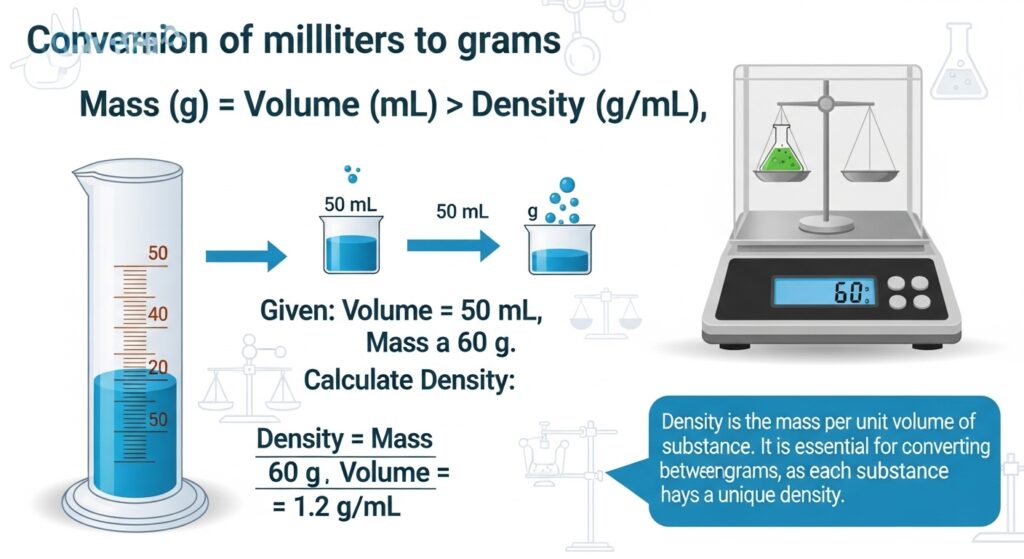
Ok, now let’s get our lab coats dusty. Chemistry geeks, pay attention. Here, volume-to-weight conversion isn’t just convenience it’s survival. You’ve got aqueous solutions, powders, and a bunch of other chemicals, and your reactions depend on stoichiometry. Mess up the mass-to-volume conversion, and your experiment fails or worse, explodes (ok, maybe don’t test explosive chemicals at home).
The same formula applies:
grams = milliliters × density
- For water, super easy: 50 mL × 1 g/mL = 50 g
- For a chemical with density 1.2 g/mL: 50 mL × 1.2 g/mL = 60 g
And yes, people like Joe Sexton and Ethan Dederick, PhD, swear by double-checking units before mixing anything. The National Institute of Standards & Technology (NIST) and the CK-12 Foundation have conversion tables that will literally save your life… or at least your lab report.
Tools to Make Conversion Easier
Look, you can do it by hand, sure. But let’s be real, who wants to calculate grams = milliliters × density every single time? Enter: conversion calculators, scales, and tables.
- Kitchen scales best for baking, especially with powders or dry ingredients
- Online calculators plug in mL, g, density, get instant results
- Conversion tables handy if you like the old-school paper route
- Apps some even allow switching between cups, tablespoons, pints, quarts, etc.
One small hack: keep a sticky note near your cooking station with your common densities. Saves trips to Google when you’re elbow-deep in flour.
Practical Examples of Milliliters to Grams Conversion
Let’s get hands-on. Suppose you’re making pancakes and the recipe calls for:
- 250 mL milk → 250 × 1.03 ≈ 258 g
- 300 mL all-purpose flour → 300 × 0.53 ≈ 159 g
- 50 mL sugar → 50 × 0.85 ≈ 42.5 g
- 30 mL cooking oil → 30 × 0.92 ≈ 27.6 g
See? It’s not scary, just a tiny bit of math magic. And if you’re prepping chemicals, just swap out the ingredient for whatever aqueous or powdered substance you’re using, plug in its density, and boom, you’re a conversion wizard.
Conversion Tips You Didn’t Know You Needed

Here’s where it gets kinda fun, like little life hacks for measurement nerds:
- Always check if your ingredient is packed or loose. Flour, for example, can vary wildly in density if scooped versus spooned.
- Use metric units consistently to avoid chaos. Mixing cups and grams randomly is recipe sabotage.
- Remember that temperature and humidity can slightly alter volume of liquids like milk or honey.
- For very small quantities, milligrams matter. Even 10 mg of a chemical can make a difference in reactions.
Common Mistakes and How to Avoid Them
- Confusing milliliters with grams without considering density
- Relying on approximate conversions for critical recipes or lab work
- Forgetting that cups, tablespoons, pints, quarts, gallons differ in metric vs US customary units
- Not calibrating your scale or using unlevel measuring cups
A quick check with NIST standards or a trusted conversion table prevents all this.
Read this Blog: https://marketbellions.com/things-that-are-6-inches-long/
Frequently Asked Questions
ml to grams
To convert milliliters (mL) to grams (g), multiply the volume by the substance’s density in g/mL. For water, 1 mL equals 1 g.
ml to g
Milliliters can be converted to grams using the formula: grams = milliliters × density. The exact value depends on the ingredient.
milliliters to grams
Milliliters measure volume, grams measure mass; conversion requires knowing the density of the ingredient or substance.
100 ml to grams
100 mL of water weighs 100 g, but for other substances, multiply 100 mL by the density in g/mL to get grams.
ml to gram
To get grams from milliliters, multiply the volume in mL by the ingredient’s density (g/mL). Different substances will have different weights.
Conclusion: Mastering Milliliters to Grams Conversion
So, why bother? Because knowing how to convert milliliters to grams transforms how you cook, bake, or experiment. It’s precision, it’s confidence, and honestly, it’s kinda fun seeing numbers click into place. Volume meets mass, science meets kitchen magic, and suddenly, measuring becomes more than a chore it’s an art.
Next time you’re in your kitchen or lab, think of each milliliter as a tiny story waiting to be translated into grams. Grab your scale, plug in your density, and watch everyday ingredients become exact, reliable, and ready for greatness.
And don’t forget: every little adjustment counts. Even 1 mL off can change the outcome so respect the numbers, and they’ll respect your taste buds (or your experiment).
Whether it’s water, milk, sugar, or cooking oil, mastering this simple metric system unit skill will make you unstoppable in the kitchen or lab. And honestly, it’s kinda satisfying to finally understand why grams ≠ milliliters most of the time.
