

Have you ever sat down and just stared at numbers, wondering why some have that little minus sign in front of them, while others don’t, and why zero even exists? Yeah, me too.
I remember as a kid, trying to figure out how my allowance could go “negative” if I spent too much on candies, and thinking, “Wait, how can I owe money if I never had any?”
That tiny moment, sitting cross-legged on the floor, flipping through my worn-out math notebook, is kinda where my fascination with Integers started. It’s funny how something so abstract can quietly shape the way we measure, reason, and even celebrate everyday life.
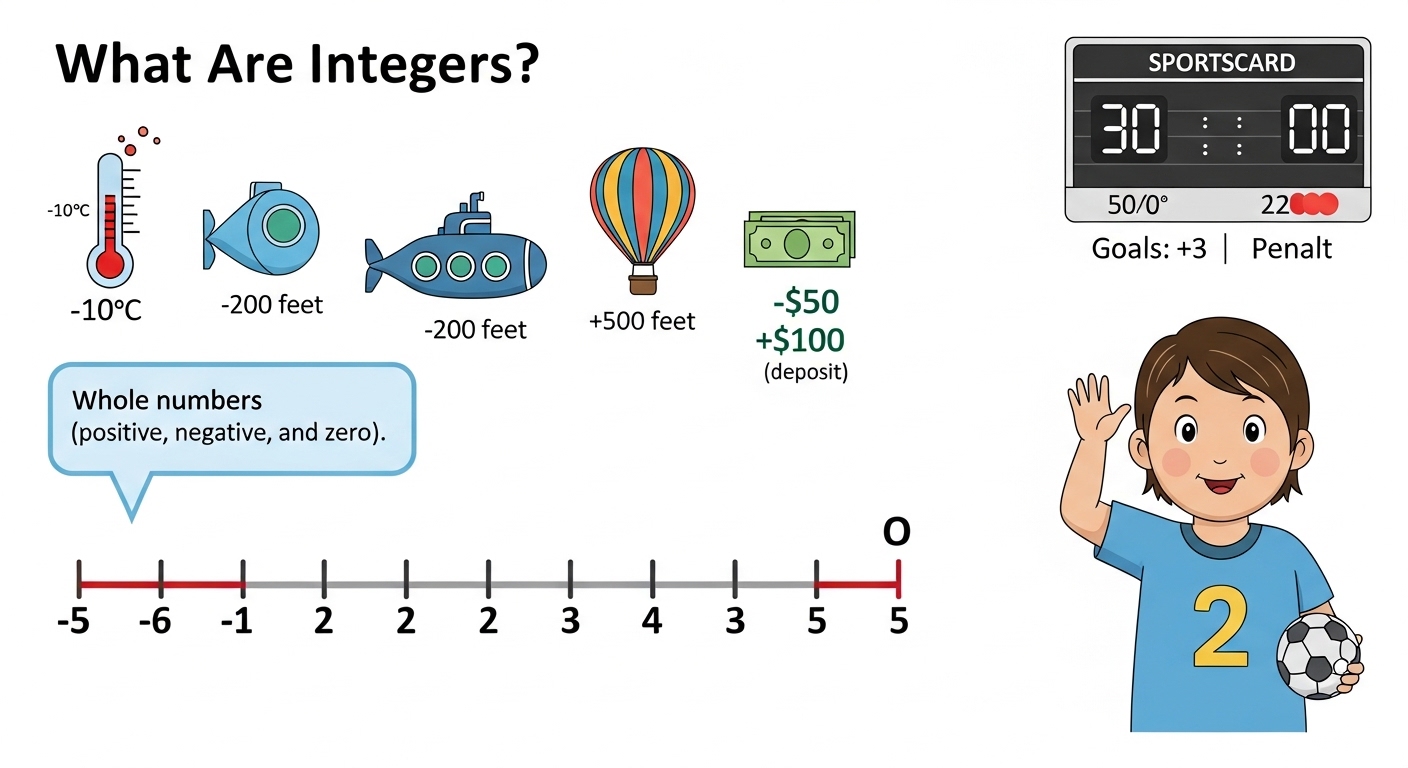
Integers are not just “numbers.” They are like a secret thread weaving through everything around us from the temperature (Celsius) outside in winter, to sports scores, from the floors of elevators to the lives in computer games.
And the more you explore them, the more you see they’re everywhere. Let’s dive into this world of numbers, opposites, and zero in a way you’ve never thought about before.
| Aspect | Explanation | Everyday Examples |
|---|---|---|
| Definition | Whole numbers that can be positive, negative, or zero | Counting steps, floors, or points in a game |
| Positive Integers | Numbers greater than 0 | Candies you have, money earned |
| Negative Integers | Numbers less than 0 | Debt, temperature below zero, basement floors |
| Zero | Neutral number, neither positive nor negative | Starting point, empty bank balance |
| Number Line | Visual representation of integers | Tracking temperature, elevations, or game scores |
| Opposites | Each positive has a negative counterpart | +3/-3 in scores, credits/debits |
| Operations | Addition and Subtraction of integers | Combining or deducting amounts, moving on number line |
| Applications | Real-life uses of integers | Weather, finance, computer games, elevators, time zones |
| Mathematical Skills | Teaches logical reasoning, problem-solving, step-by-step thinking | Algebra, coding, puzzles, arithmetic |
| Historical & Cultural | Origins and significance | Zero in Ancient India, “integer” from Latin”, math evolution |
What Exactly Are Integers?
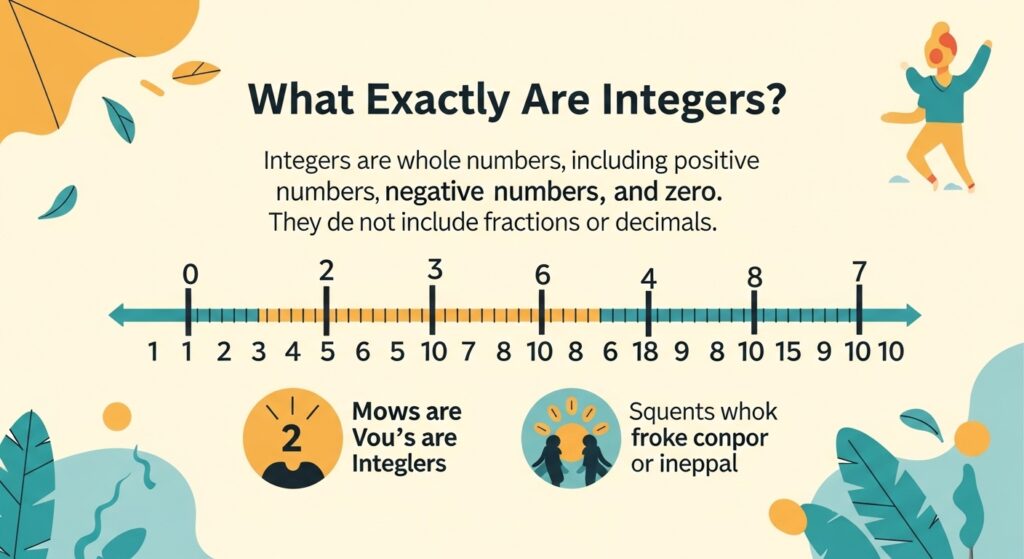
At their heart, Integers are whole numbers that can be positive, negative, or zero. They don’t include fractions or decimals they are whole, solid, indivisible units. Think of them as the backbone of counting in both directions.
- Positive integers: These are numbers greater than zero, like 1, 2, 3… the numbers you count candies with or the steps you climb.
- Negative integers: Numbers less than zero, like -1, -2, -3… these represent debts, drops in temperature, or levels below ground.
- Zero:
- The neutral middle, neither positive nor negative. Fun fact: zero actually has roots in Ancient India, where it was first used as a placeholder in calculations, revolutionizing math forever.
The word “integer” itself comes from Latin, meaning “whole” or “untouched.” It’s like numbers with a sense of purity, unbroken and fundamental to Mathematical Concepts.
The Number Line: A Visual Playground
If integers were a movie, the number line would be the set. Imagine a straight horizontal line. Zero sits calmly in the center, positive integers stretch to the right, negative integers slide to the left. Every step along this line represents movement, measurement, or change.
Picture this: you’re tracking the temperature (Celsius) during a snowstorm. Morning: -2°C, Afternoon: 3°C. You’re literally hopping along the number line in your head, understanding rise and fall. Or m
aybe you’re playing a game where your character loses 5 health points, then gains 7… suddenly, integers become your secret toolkit for survival.
The number line isn’t just visual it teaches logical reasoning, step-by-step problem solving, and gives a tangible sense to abstract math. Without it, integers would just be squiggles on a page.
Opposites and Their Charm
One of the quirkiest things about Integers is that every positive number has a mirror in the negative. +3, -3; +12, -12. These opposites are everywhere:
- Weather forecasts: highs and lows.
- Bank account balance: credit vs debt.
- Gaming scores: life gained vs life lost.
Understanding opposites helps kids and adults alike grasp mathematical thinking in the real world. And sometimes, it’s poetic just like life, for every up there’s a down, for every gain a loss, and integers quietly reflect that balance.
Addition and Subtraction: More Than Just Rules
When we talk about integers, we can’t ignore Addition and Subtraction. But let’s shake off the boring textbook vibe. Think of it like moving around a map of your daily life:
- You start with 4 candies (positive integer), eat 2 (subtract), now 2 left. Simple.
- The room’s temperature drops from 3°C to -2°C, a shift of 5 degrees. That’s subtraction with negatives, and suddenly math feels like storytelling.
These operations also form the base of Algebra and Geometry. When students start solving for x, or plotting coordinates, integers are silently making all those shapes, lines, and patterns possible.
Applications of Integers in Everyday Life
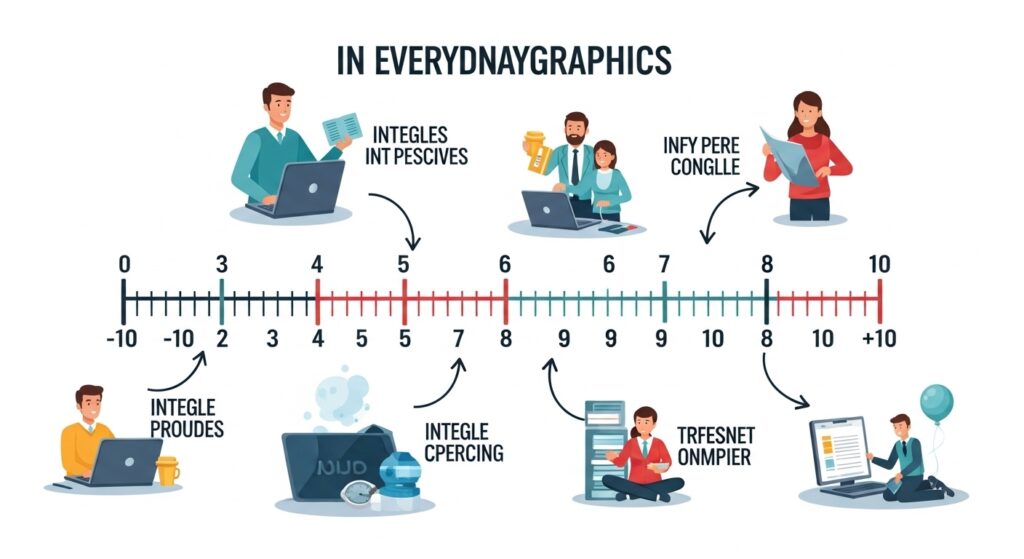
If you think integers are just for the classroom, think again. They sneak into everyday experiences:
- Candies counting: How many you have, how many you give away, how many you owe.
- Temperature (Celsius): Negative winters, hot summers, seasonal swings.
- Weather forecasts: Predicting highs and lows using positive and negative numbers.
- Sports scores: Tracking wins, losses, and point differentials.
- Allowance / Bank account balance: Income vs spending, credits vs debits.
- Computer games: Health points, lives, and prizes often use integers to track progression.
- Elevators: Floors above (positive) and below (negative).
- Time zones: Calculating UTC+5:30 or UTC-5, using integers to coordinate global life.
Without integers, navigating everyday life would feel like walking blindfolded.
Learning and Practicing Integers
Mastering integers isn’t just memorization it’s practice examples, integer puzzles, and playful exploration. Many math curriculums now use:
- Number line activities
- Online math classes
- Stepwise calculations
- Integer visualization exercises
Even simple games like hopping along a floor plan of a building or tracking points in a game teach kids numerical reasoning and logical number relationships. Think of it as a mental gym for your brain.
Fractions, Decimals, and Whole Numbers: The Broader Family
Integers are cousins with fractions, decimals, and whole numbers, forming the Mathematical foundation. While integers stay whole and unbroken, fractions and decimals let us slice, dice, and measure more precisely. But the beauty of integers is in their simplicity they give structure to the messy, continuous world of numbers.
- Whole numbers = integers ≥ 0
- Fractions/Decimals = pieces of integers
- Operations with integers often guide the manipulation of these more delicate numbers
It’s kinda like learning to walk before running a marathon. Without integers, fractions and decimals would have no stable ground to build upon.
Historical and Cultural Nuggets
Did you know the concept of zero emerged in Ancient India? Or that the word “integer” comes from Latin, meaning whole? These little historical tidbits show how numbers weren’t just about counting they were about philosophy, logic, and culture.
Across cultures, integers have been woven into calendars, construction, commerce, and even art. In coding and programming, integers track everything from time zones to scores in complex simulations. They’re silently shaping civilizations and daily life alike.
Logical Reasoning and Step-By-Step Thinking
Integers don’t just help you count they teach step-by-step problem solving, logical reasoning, and critical thinking. Want to calculate a family trip across different time zones? Or predict weather changes over a week? Integers guide you in precise, reliable ways.
Even simple tasks like figuring out your bank balance after a week of spending and deposits require understanding positive and negative numbers. Integers make abstract logic visible and actionable.
Fun with Integer Puzzles
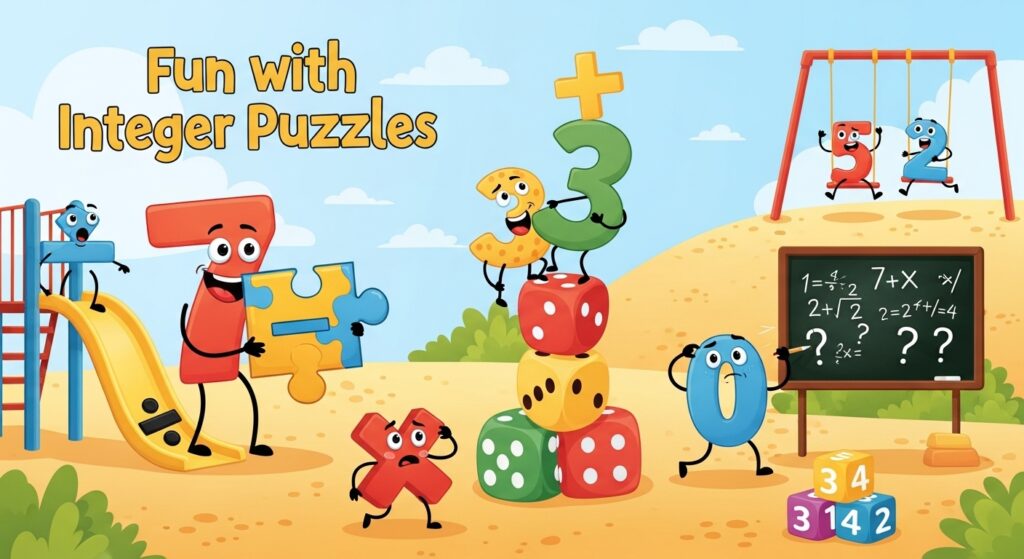
One of the best ways to get comfy with integers is through practice exercises and integer puzzles. Kids love games like:
- “Move 3 steps forward, then 5 back” on a number line
- Coding challenges where lives go up or down
- Bank balance simulations with deposits and withdrawals
These puzzles subtly teach numerical reasoning, integer visualization, and the beauty of opposites. It’s math disguised as fun.
Integers in Coding and Programming
In programming, integers are superheroes. They track lives in computer games, manage scores, and even guide logical reasoning in AI. Without integers, software would struggle to represent discrete quantities reliably. Every line of code that loops, counts, or calculates depends on these whole, solid numbers.
Creative Takeaways: Why You Should Care About Integers
Integers aren’t just abstract math. They are part of our everyday story. Every temperature change, sports score, financial calculation, and gaming achievement relies on them. They help us track, compare, add, subtract, and visualize. They teach patience, logical thinking, and step-by-step reasoning. They give the messy, chaotic world of numbers structure, clarity, and even beauty.
Practical Ways to Engage With Integers
- Play integer puzzles online or offline
- Track your daily life with integers bank balance, calories, steps
- Visualize your week on a number line
- Challenge yourself with negative numbers temperatures, scores, elevations
- Teach kids integers using candies, games, or elevators
The more you interact, the more natural integers become.
Frequently Asked questions
integers
Integers are whole numbers that can be positive, negative, or zero, without any fractions or decimals. They are used to represent values in everyday life and mathematics.
what is a integer
An integer is a number that is complete and whole, including positive numbers, negative numbers, and zero. It does not include fractions or decimals.
integer number
An integer number refers to a value from the set {…, -3, -2, -1, 0, 1, 2, 3, …} and can be used in counting, scoring, or calculations.
integer meaning in math
In mathematics, an integer is any whole number that may be positive, negative, or zero, used for arithmetic operations and problem-solving.
interger
“Interger” seems to be a typo for “integer,” which is a whole number, either positive, negative, or zero, without fractions or decimals.
Read This Blog ;https://marketbellione.com/what-is-a-participle-phrase/
Conclusion: The Silent Superheroes of Math
Integers might seem simple at first glance just positive numbers, negative numbers, and zero. But peel back a layer and you see a rich universe of logical reasoning, problem-solving skills, and real-world applications.
They quietly measure the rise and fall of temperatures, the gains and losses in games and finance, and the steps we take along the number line of life.
So next time you check your bank balance, peek at the weather, or climb floors in an elevator, remember: integers are the invisible helpers making sense of it all.
They’re not just numbers they’re stories, patterns, opposites, and balance. And once you see that, you’ll never just glance at a number the same way again.