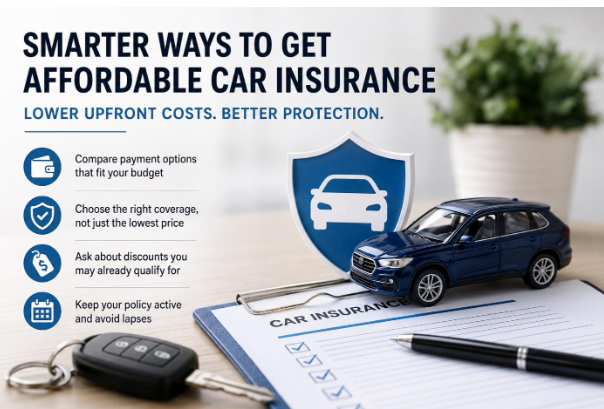

Car insurance is often discussed as a monthly expense, but for many drivers, the most difficult part is the first payment. A policy may look affordable over six months yet still require a higher amount upfront than expected. That is why many shoppers now pay close attention to low-upfront car insurance options, monthly payment plans, discounts, and the real cost of keeping coverage active.
At the same time, choosing auto insurance only by the lowest first payment can create problems. A lower upfront cost may help a driver start coverage, but it does not automatically mean the policy is the best deal. The real question is whether the plan offers enough protection, has reasonable fees, and can be maintained without causing a lapse.
Before choosing a policy, drivers should look at the full picture: first payment, monthly installments, deductible, coverage limits, policy fees, cancellation terms, and the insurer’s requirements. A useful guide on choosing a low-upfront car insurance plan explains why drivers should compare the payment structure carefully instead of focusing only on the amount needed to begin coverage.
Why the First Payment Gets So Much Attention
The first payment matters because it can determine whether a driver can start coverage immediately. Someone who needs insurance today may not have enough cash available for a large down payment. This can happen after buying a vehicle, moving to a new state, switching insurers, renewing after a lapse, or adding a new driver to the household.
Low-upfront plans can be helpful in these situations because they spread more of the cost across the policy term. However, drivers should remember that spreading out payments may also increase the total cost if installment fees or other charges apply. A smaller first payment can make coverage easier to start, but it should not hide the full financial commitment.
That is why the best comparison is not “Which quote has the lowest first payment?” but “Which quote gives me the best balance of upfront cost, total premium, coverage, and payment reliability?”
The Total Cost Matters More Than the Advertised Price
Two car insurance policies can look similar at first but have very different costs over time. One policy may require a lower first payment but higher monthly installments. Another may require more upfront but cost less overall. A third may advertise a low payment but include fees that make the total price less attractive.
Drivers should compare the complete payment structure before deciding. This includes the first payment, monthly payment, total premium, installment fees, policy fees, late payment rules, and cancellation terms. Looking at only one number can lead to a weak decision.
| Comparison point | What drivers should review | Why it matters |
|---|---|---|
| First payment | The amount needed to activate the policy. | A low first payment can help with cash flow, but it may not mean the policy is cheaper. |
| Monthly installment | The recurring payment after coverage begins. | A policy must be affordable enough to keep active every month. |
| Total premium | The full six-month or annual cost. | The lowest starting cost may still become expensive over time. |
| Deductible | The amount paid out of pocket after certain claims. | A higher deductible can lower premium but increase financial risk. |
| Coverage limits | Liability limits and optional coverages. | Lower limits may reduce price but may not provide enough protection after a serious accident. |
Drivers Should Avoid Cutting Coverage Too Quickly
When a premium feels too high, some drivers immediately reduce coverage. That can lower the price, but it can also create a bigger problem later. Lower liability limits, dropping collision or comprehensive coverage, or choosing a very high deductible may reduce the bill, but those choices also shift more financial responsibility to the driver.
For example, liability-only coverage may make sense for some older paid-off vehicles, but it usually does not repair the driver’s own car after an at-fault accident. A higher deductible may lower monthly cost, but it requires the driver to have enough savings available after a claim. State minimum liability coverage may satisfy legal requirements, but it may not be enough after a serious crash.
Before reducing coverage, drivers should ask what they would actually be responsible for if something went wrong. Saving money is useful only if the policy still protects against the risks that matter most.
What Optional Car Insurance Could Mean for Drivers
Auto insurance is required in most states because accidents can create large costs for drivers, passengers, pedestrians, and property owners. If car insurance were optional, some drivers might choose to skip coverage to save money. That could create serious problems after crashes, especially when an uninsured driver cannot pay for injuries or damage.
This is one reason insurance requirements exist: they help create a basic financial safety net on the road. A deeper discussion of what would happen to U.S. insurance companies if car insurance became optional shows how changing insurance requirements could affect drivers, insurers, claim costs, and the broader market.
Even when drivers are focused on finding affordable coverage, the larger point remains the same: insurance is not just a monthly bill. It is a way to manage financial risk. The goal should be to find a policy that is affordable enough to keep active while still offering meaningful protection.
Payment Plans Should Support Continuous Coverage
One of the biggest mistakes drivers can make is letting a policy lapse. A lapse can happen when a payment is missed, an old policy is canceled before a new one begins, or a driver delays renewal. Even a short gap can create issues depending on the state, insurer, and driver profile.
Continuous coverage can help drivers avoid legal trouble, registration problems, lender issues, and future pricing challenges. For drivers who need a low-upfront policy, the plan should be affordable not only on day one, but also every month after that.
A policy that starts cheaply but becomes too difficult to maintain can lead to cancellation. That is why drivers should choose a payment plan that fits their real budget, not just a plan that looks attractive at the beginning.
Discounts Can Help Before Coverage Is Reduced
Before lowering coverage, drivers should ask about available discounts. Depending on the insurer and state, savings may be available for safe driving, prior insurance, multiple vehicles, good student status, anti-theft devices, electronic payments, paid-in-full options, renewal history, or claim-free driving.
Discounts are not always automatic. Some require proof, and some vary by state or company. Drivers should ask directly and then check the quote or declarations page to confirm that approved discounts were applied.
This approach can be safer than cutting protection too quickly. If a discount reduces the premium without weakening coverage, the driver gets a better result than simply removing important policy features.
A Practical Checklist Before Choosing a Plan
Drivers comparing low-upfront or monthly auto insurance plans should slow down and review the details carefully. A policy should be judged by its full value, not by one attractive payment number.
- Compare the first payment, monthly payment, and total premium.
- Check whether installment fees or policy fees are included.
- Use the same liability limits and deductibles across quotes.
- Ask about discounts before reducing coverage.
- Choose a deductible that would be realistic after a claim.
- Confirm that all drivers and vehicles are listed correctly.
- Make sure the new policy is active before canceling old coverage.
- Review cancellation rules and late payment terms.
- Keep proof of insurance available after purchase.
Final Thoughts
Lower upfront car insurance can be useful for drivers who need coverage without a large first payment. However, affordability should not be confused with weak protection. The best policy is not always the one with the smallest payment today. It is the one that balances startup cost, monthly affordability, total premium, coverage, deductibles, and long-term reliability.
Drivers should compare carefully, ask about discounts, avoid lapses, and understand what each coverage choice means before buying. A smart payment plan can make insurance easier to manage, but the policy still needs to protect the driver when it matters most.
